
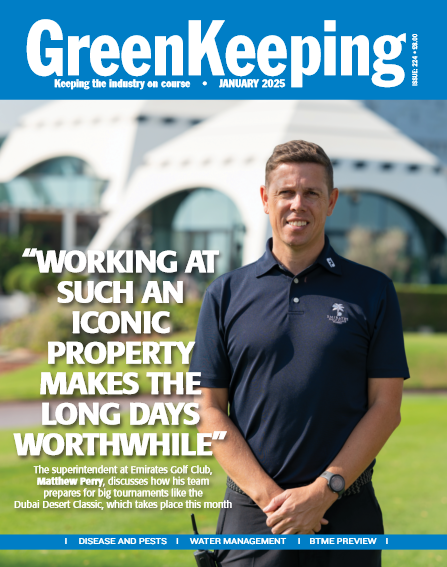
Matthew Perry, who worked at various golf clubs in the UK before emigrating to the Middle East nearly 20 years ago, is the superintendent at Emirates Golf Club, Dubai, one of the region’s leading venues. He discusses his career, his day-to-day work and how his team prepares for big tournaments, like the Dubai Desert Classic.

Can you tell us about your career to date and what your current position at Emirates Golf Club entails?
I started greenkeeping when I was 18 years old. After leaving school, I knew that I wanted to be in the golf industry, even though I realised that I wasn’t good enough to be a professional player. So, I then decided to study golf course management for three years, and during that time I gained extremely valuable work experience at some amazing clubs around the UK.
I moved to Bahrain in 2006, at the age of 26. I was familiar with the region because my parents had lived in Saudi Arabia for a number of years. Bahrain was where I really developed an understanding of warm-season grasses and learned to manage the island’s unfamiliar, harsh weather conditions.
I was then headhunted to make the move over to Dubai, and to Emirates Golf Club as assistant superintendent on the Faldo course. This was a huge step up from my role in Bahrain. I was involved in several projects during my time in that position, including the installation of floodlights on all 18 holes of the Faldo Course.
Within 18 months, I was promoted by the Dubai Golf group to head over to one of their other venues in Dubai, Dubai Creek Golf and Yacht Club, as the superintendent – where I stayed for seven and a half years. I then returned to Emirates Golf Club in 2018 and have been here ever since. During Covid my role evolved a bit, because I was simultaneously overseeing the greenkeeping operations at Emirates Golf Club, Dubai Creek and Dubai Golf’s third golf club in Dubai, Jumeirah Golf Estates. During that time, we also managed four professional tournaments in just a three-month window. Now, I focus solely on Emirates Golf Club.
In recent years, we’ve made major improvements, including replacing 30-year-old greens on the Majlis Course with brand-new greens, and we’ve also introduced drainage underneath those greens for the first time. We’re constantly pushing ourselves to set the benchmark in quality, sustainability and tournament preparation.

Can you explain a little about the day-to-day responsibilities you have at Emirates Golf Club and what it’s like to work in such a renowned golf facility?
My day starts early. My team begins at 4:00am, and I usually arrive between 5:00 and 5:30am. When I get in, I spend two to three hours on the course inspecting conditions and walking through some projects with the team. I work closely with two excellent assistants, Mario and Jordan, who manage specific responsibilities for our two courses. I empower my team to make decisions and take responsibility. Many of my staff have more than 25, or even 30, years of experience.
Throughout the day, I oversee tasks like monitoring irrigation, managing moisture levels, planning fertility programmes, and reviewing scheduling. Golf course maintenance involves more than just the course itself — Emirates Golf Club is a huge facility, and we handle landscaping for areas like the clubhouse, Topgolf and padel courts.
It’s a busy role, with long days ending around 4:30 or 5:00pm, but working at such an iconic property makes it all worthwhile.
Emirates Golf Club is home to one of the longest-standing DP World Tour events, the Dubai Desert Classic. How does it feel to be part of the team that is responsible for producing a golf course for the world to see?
It’s an incredible privilege. The Dubai Desert Classic has such a rich history, with legendary winners like Seve Ballesteros, Tiger Woods, and Rory McIlroy. The tournament has continued to grow over the years, recently becoming part of the DP World Tour’s Rolex Series, which adds even more prestige and brings with it a strong field.
The golf course itself is iconic. It’s been around since 1988 and offers an old-school feel, which is rare in this part of the world. It’s also a great viewing course for spectators, with holes that interconnect beautifully, allowing guests to see multiple areas at once.
For us as greenkeepers, tournament golf is a chance to showcase our work on a global stage. It’s a thrill to know our efforts contribute to such a major event, and it keeps us motivated to deliver the best possible conditions.

How do preparations for the Dubai Desert Classic differ from regular maintenance on the Majlis Course?
Preparing for the tournament is a year-round process that intensifies after Christmas. For example, we protect the greens by limiting the number of hole locations in the lead-up to the event. This ensures we avoid excessive wear and tear and can present the greens in perfect condition.
We also shift all team resources to the Majlis Course once the Faldo Course is set up in the morning – during the few weeks before the tournament. This allows us to focus on detailed work like edging desert areas, trimming trees and preparing bunkers. These tasks are part of regular maintenance but are condensed into a short timeframe before the tournament.
During the event, the standards are heightened, with extensive cutting and rolling to ensure the greens are fast and firm. It’s a completely different level of preparation compared to everyday play, as it needs to suit the requirements of the DP World Tour, and provide a stern but fair test for the world’s best players.
Are there any particular challenges that you guys have faced in the build-up to this year’s tournament, and how have you overcome them?
Climate variability has been a significant challenge. For example, a few years ago, we didn’t have rain for 18 months, but more recently, we’ve experienced severe storms, including one of the worst in UAE history.
Rain can disrupt scheduling and soften the course, which isn’t ideal for tournament play. We have to monitor these conditions closely to maintain firm playing surfaces. Additionally, with players hitting longer shots, we’ve stretched the course to its maximum length and adjusted fairways, rough and tightly mown areas around the greens to maintain a fair challenge.
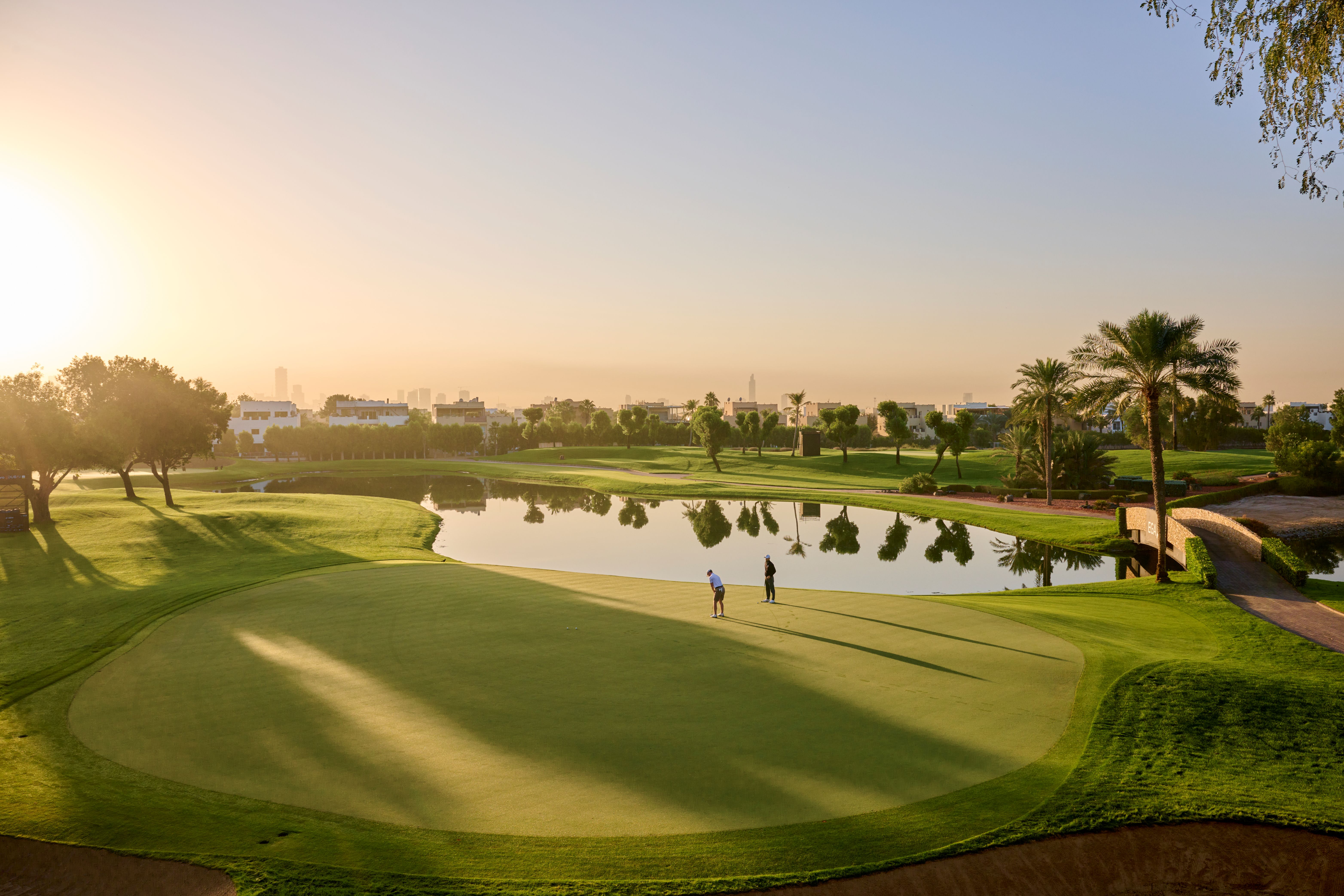
Will there be any noticeable differences to the course layout for this edition of the Hero Dubai Desert Classic?
The most significant change is on the second hole, which has been adjusted to improve pace of play. We’ve moved the tee back and extended the rough on the left side to make it more challenging for those players attempting to drive the green.
We’ve also softened some desert areas to make them less predictable to hit from, encouraging strategic play. These changes aim to strike a balance between challenging the players and also delivering an exciting event for spectators and viewers at home on the television.
Emirates Golf Club recently won a European Tour Sustainability Award for the Dubai Desert Classic. Can you tell us a bit more about that?
Sustainability has been a major focus for us, and it’s fantastic to see those efforts recognised. Over the years, we’ve introduced initiatives like switching floodlights to LEDs, installing solar panels, and eliminating single-use plastics.
During the tournament, we recycle materials like hospitality carpets, repurposing them into tools like drag mats. We also use Harris Hawks to manage crow populations in an eco-friendly way.
These efforts showcase our commitment to reducing the environmental impact of golf, and it’s great to see other clubs in the region adopting similar practices. We’re particularly proud to have been recognised by the tour for our efforts in making the running of the Dubai Desert Classic a more sustainable operation.
Finally, are there any unique quirks we should look out for during the tournament? For example, how quick are you planning to run the greens, and will there be a difference in rough height to normal?
The greens are planned to run at an average speed of 13.3 on the stimpmeter, which is consistent with the speeds that the players faced last year. We’re also aiming for thicker rough to penalise wayward shots from the tee and into greens, which will encourage a bit more of a precision-based game plan.
We typically review the course layout right after the previous Desert Classic, looking at what went well, and what we can change to alter the test for the players next time out. So, by the time the next edition comes around, we’ve carefully planned these details to provide a fair but challenging test for players while delivering an exciting experience for spectators too.