
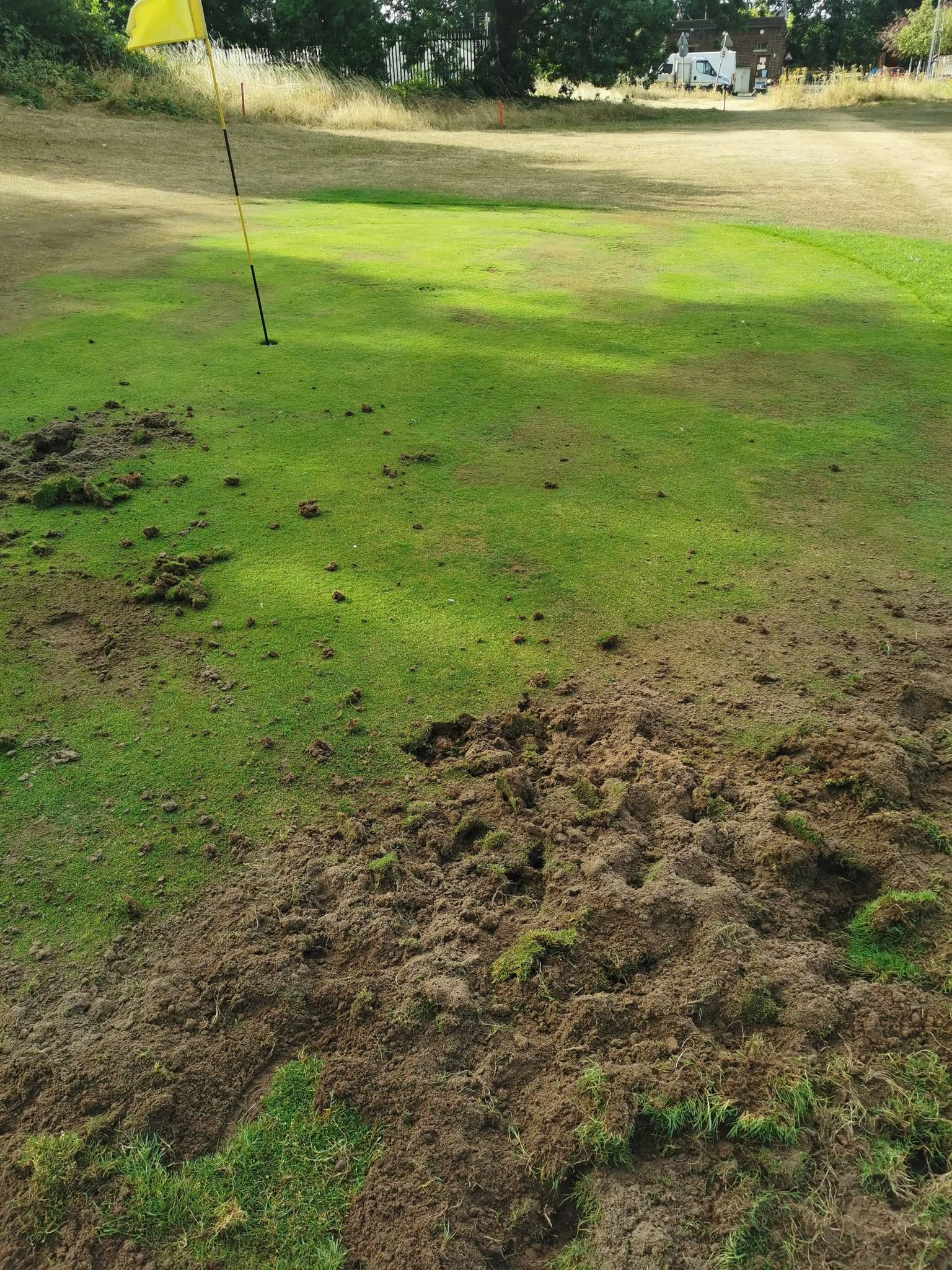
Golf courses across England and Wales are reporting significant badger damage to greens, tees and fairways as the drought pushes wildlife onto the only soft ground left on site – the areas greenkeepers have been irrigating.
Damage has been reported in Suffolk, Staffordshire and Worcestershire, with affected clubs describing turf being lifted and turned over overnight.
At Clare Park Lake Golf Course in Clare, Suffolk, owner Susan Moore said parts of the course had been left “churned up and like a ploughed field”. The club has resorted to rolling netting across affected areas once play has finished for the day, leaving a radio playing overnight and using flashing lights in an attempt to deter the animals.
Why irrigation has become the problem
The pattern is a direct consequence of the weather. With drought conditions affecting nearly all of Wales and around three-quarters of England, unirrigated ground has baked hard. Watered turf, by contrast, stays soft enough to dig and retains the moisture that drives invertebrate activity near the surface.
The result is that the most intensively managed areas of the course – precisely those a course manager can least afford to lose – become the most attractive foraging ground available for several hundred metres.
The target is chafer grubs, the root-feeding larvae of chafer beetles, with August marking the start of the period when grubs are typically present in numbers. Badgers, foxes and corvids will all dig or tear turf to reach them.
It is worth being clear about the sequence, because members rarely are: the grubs themselves cause direct feeding damage that can thin and yellow turf, and in severe cases allow it to be peeled back by hand. But the damage that ends up on the club WhatsApp group is almost always secondary – predators rooting through the surface. A high larval population next to an active sett can produce ploughed-field damage on a fairway in a single night.

No realistic control options
What makes this season’s damage a genuine story rather than a seasonal grumble is that greenkeepers have very little left to work with.
The soil-acting insecticides once used to manage chafer and cranefly larvae are no longer approved for use in the UK, leaving no conventional chemical option when fairways or tees come under attack. Badgers and their setts are protected by law, so the animals themselves cannot be interfered with.
That leaves cultural and biological approaches, both of which are compromised this year. Rolling, coring and tining can create a more hostile environment for larvae, but carry an obvious cost to playing surfaces and cannot be deployed at short notice across large areas. Nematodes offer biological control of chafer larvae in July and August, but require a narrow set of soil conditions to move and survive – and in a drought summer, greens and fairway soils are frequently too dry for them to work. By September, when leatherjacket control becomes the priority, soil temperatures are often already too low.
In other words, the two windows in which biological control is theoretically available are the two windows the weather has closed.

What clubs can do
For most course managers the realistic response this month is deterrence, damage limitation and communication.
Physical exclusion – netting vulnerable areas after play – is labour-intensive but is being used in practice. Overnight noise and light disturbance has been tried, with the usual caveat that badgers habituate quickly and any deterrent needs varying.
Beyond that, the priority is repair capacity: having rootzone, seed and labour available to reinstate damaged areas quickly, and accepting that recovery will be slow while soil moisture remains limited.
Communication matters more than usual. BIGGA produces a member-facing leaflet and a clubhouse poster explaining chafer grub and leatherjacket damage, both available to download from its website. Given how visible and how alarming this damage looks to golfers – and how easily it is misread as neglect – putting an explanation in front of members before they draw their own conclusions is time well spent.
The wider point is one the industry has been making for some years. The withdrawal of plant protection products has left turf managers reliant on integrated approaches that depend on favourable conditions to function. This summer has removed those conditions, and the consequences are now visible from the first tee.
Integrated pest management in practice will be a feature area at GroundsFest next month, where the Amenity Forum is running a dedicated IPM in Practice zone.