
The former course manager at Ashridge and Letchworth golf clubs in southern England, James Camfield, is now director of Golf Course Management Services (GCMS), which offers support to greenkeepers. He speaks to irrigation expert John Kidson about how long-term course sustainability can be achieved via effective water management.
James Camfield’s company specialises in supporting golf course managers with any aspect of their role. This includes construction projects, tee levelling, bunker construction, freelance greenkeeping, specialist machinery hire, woodland management and full-scale landscape shaping. He also works with Irritech, the irrigation consultancy.
Known for his hands-on approach and deep understanding of irrigation systems within the construction process, James shares his perspective on how water management influences design, efficiency and long-term course sustainability.
From your perspective, how has the role of irrigation evolved in golf course construction over the past decade?
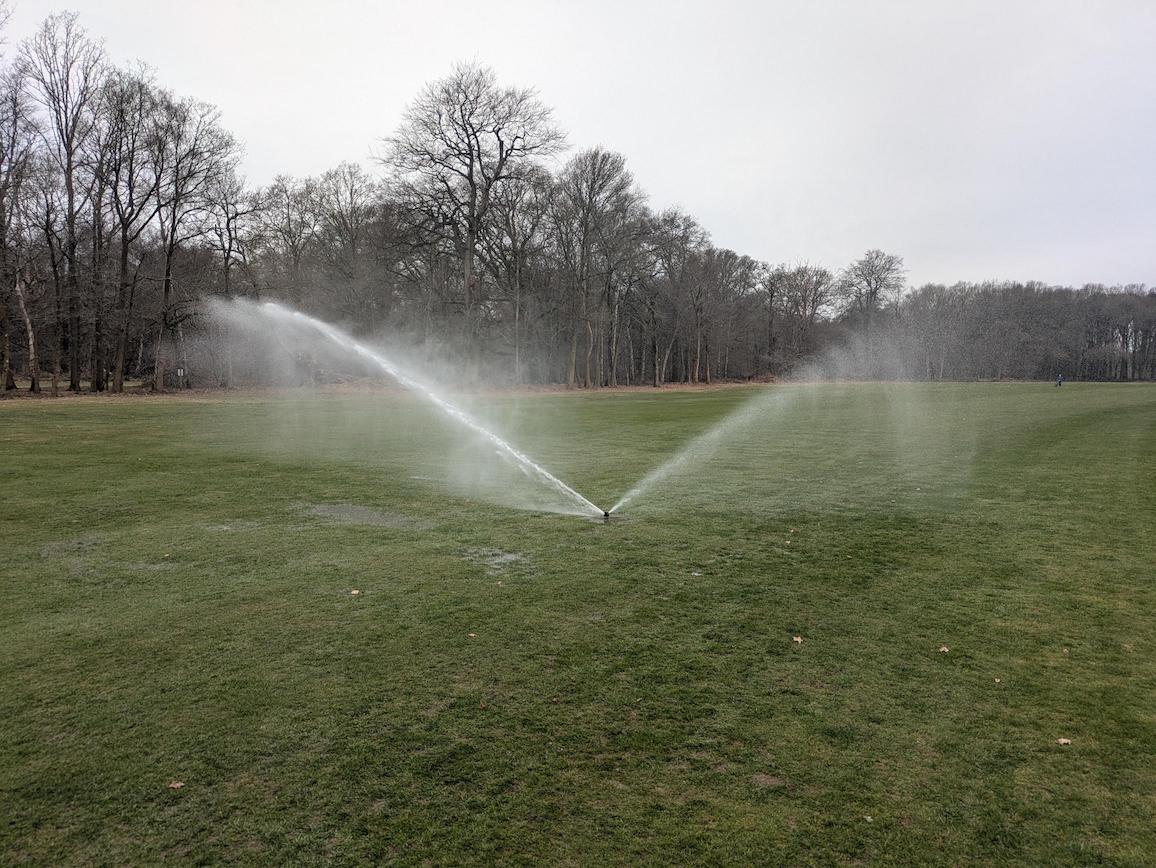
Water management, in general, has been the focus of most turf managers over the last decade. Over this period, we have witnessed extremes in weather conditions with the wettest winter and driest summer on record. Irrigation technology investment has boomed over the last 20 years. Many golf courses have been able to invest in state-of-the-art irrigation systems, while others have some catching up to do. Golf course construction enables the development of more efficient systems.
For example, sprinklers can be chosen and located in the most effective layout possible and the use of a polyethylene pipe, which has a 50-year manufacturer’s warranty, can be installed.
When you’re levelling or rebuilding tees, what are the main factors that influence your approach to water management?
We work with clients to ensure that ample drainage is installed, and suitable soil types are used. We also ensure that the rootzone depth is very consistent, this creates a perched water table enabling the grass to access as much water as possible through its root system. We always avoid compacting or damaging soil which can happen if the soil is too wet during construction. We also could create shapes and sizes of tees which naturally suit irrigation layout.
How do you balance efficiency and aesthetics when positioning sprinklers or specifying nozzle types for new builds?
This is carried out at design stage, which enables the new build to be a suitable shape and size to meet the client’s brief and complement the natural environment. We also consider the best fit for the sprinkler system. We chose sprinklers, nozzles, arcs and pressures to ensure the sprinklers achieve head-to-head contact without unnecessarily watering periphery areas that don’t require irrigation. Choosing the best irrigation configuration for consistent coverage is always a major consideration. Getting irrigation right at the point of installation means it’s going to be right for decades to come.
What differences have you seen between traditional tee irrigation setups and more modern systems in terms of water use and turf performance?
Employing valve-in-head sprinklers has typically been based on greens, approaches and fairways with block systems used on tees. Valve-in-head sprinklers are individually operated so their radius, nozzles, arcs and pressures can be individually set. This enables water to be applied exactly where it is required. Nozzle radius for valve-in-head sprinklers can now be set as little as 11 metres, so valve-in-head use on tees is becoming increasingly popular for water conservation. Block sprinklers still serve a purpose on small tees, regular-shaped tees and where control systems or financial constraints dictate.
Do you think the cost of installing a well-designed irrigation system pays back over time through reduced maintenance or water savings?
Definitely. Irrigation systems are in essence a mechanical system made up of materials that deteriorate. They have a limited lifespan, particularly if they have PVC pipework which is glued together and becomes brittle with age. Therefore, every owner of an irrigation system should have a contingency for replacing or upgrading their system. At that point there is an opportunity to enhance the irrigation system to make the most of the latest technology. All irrigation systems require maintenance. Irrigation systems tend to be neglected because they’re mostly buried underground and they become an afterthought. Irrigation maintenance is often reactionary, because of faults. Faults become more frequent on older or poorly designed systems. The better they are maintained the longer they will last and more efficient they will be. Every irrigation system should be audited on a regular basis to ensure water is not being wasted and the system is reliable / fit for purpose and, most importantly, safe to operate. If there are problems, investment should be made.
In your experience, what’s the biggest mistake clubs make when budgeting or planning irrigation for new tees or bunkers?
Generally, not abiding by irrigation design principles and cutting corners to save capital expense. This is a false economy. Sometimes it can look like too many sprinklers have been installed. But it’s not just about saving water. For example, having six sprinklers around a rectangular tee rather than two sprinklers in the middle saves a considerable amount of water. It also reduces the irrigation run time by 70 to 80 percent. That saves a lot of electricity and reduces pump wear and tear.
How do you see changing weather patterns and water restrictions influencing the way golf courses are built or renovated in the future?
Water sourcing is a hot topic now. The balance of water required against the amount of water available is becoming increasingly stretched. More clubs are thinking about building water storage reservoirs if the land is available and if they are permitted from a planning perspective. Ultimately, if the water isn’t available in the required amounts, turf will suffer during drought. In this scenario it usually leads to the need for proactive communication with the clientele as to why conditions are suffering during drought and having a really good recovery (overseeding) plan.
Are there specific nozzle or sprinkler configurations you’ve found particularly effective for tees or small zones?
Keeping things consistent is crucial. Stick with one brand throughout, whichever that may be out of the big three. The sprinkler system is calibrated against the given brands’ controller. Mix and match is never a good idea and make sure the system data is calibrated and up to date.

What lessons have you learned about coordinating irrigation installation alongside other course construction work like drainage or turfing?
There is certainly a conflict between irrigation pipe and drainage pipe. Both in the ground around the same depth and both essential in the roles they serve. Accurate GPS records of location and depth of pipe is the best help, followed by scanning for cable installed with the irrigation. If a club is looking to make installations, planning and having a plan for repairing pipes is crucial.
If you could give one piece of advice to course managers considering a renovation, what would it be regarding irrigation planning and design?
Having been a course manager in this scenario, I would say, stick to the sound irrigation principles and if you don’t feel 100 percent comfortable, seek professional irrigation support. Once irrigation is in the ground it is very time-consuming to alter. Paying for advice to get it right the first time will save a fortune, save water, save electricity, reduce wear and tear, save embarrassment and ensure that the turf has the best opportunity to be awesome!
For more information on GCMS (James), visit www.gcmsltd.com.
Also see @JKIrrigation (John) on social media